In her national bestseller Alice I Have Been, Melanie Benjamin imagined the life of the woman who inspired Alice in Wonderland. Now, in this jubilant new novel, Benjamin shines a dazzling spotlight on another fascinating female figure whose story has never fully been told: a woman who became a nineteenth century icon and inspiration—and whose most daunting limitation became her greatest strength.
“Never would I allow my size to define me. Instead, I would define it.” She was only two-foot eight-inches tall, but her legend reaches out to us more than a century later. As a child, Mercy Lavinia “Vinnie” Bump was encouraged to live a life hidden away from the public. Instead, she reached out to the immortal impresario P. T. Barnum, married the tiny superstar General Tom Thumb in the wedding of the century, and transformed into the world’s most unexpected celebrity.
Here, in Vinnie’s singular and spirited voice, is her amazing adventure—from a showboat “freak” revue where she endured jeering mobs to her fateful meeting with the two men who would change her life: P. T. Barnum and Charles Stratton, AKA Tom Thumb. Their wedding would captivate the nation, preempt coverage of the Civil War, and usher them into the White House and the company of presidents and queens. But Vinnie’s fame would also endanger the person she prized most: her similarly-sized sister, Minnie, a gentle soul unable to escape the glare of Vinnie’s spotlight.
A barnstorming novel of the Gilded Age, and of a woman’s public triumphs and personal tragedies, The Autobiography of Mrs. Tom Thumb is the irresistible epic of a heroine who conquered the country with a heart as big as her dreams—and whose story will surely win over yours.
Melanie Benjamin was born in Indianapolis, Indiana. An avid reader all her life—as a child, she was the proud winner, several years running, of the summer reading program at her local library—she still firmly believes that a lifetime of reading is the best education a writer can have.
While attending Indiana University—Purdue University at Indianapolis, Melanie performed in many community theater productions before meeting her husband, moving to the Chicago area and raising two sons. Writing was always beckoning, however, and soon she began writing for local magazines and newspapers before venturing into her first love, fiction. As Melanie Hauser, she published two contemporary novels.
By incorporating her passion for history and biography, Melanie, now writing as Melanie Benjamin, has finally found her niche writing historical fiction, concentrating on the "stories behind the stories." ALICE I HAVE BEEN is her first historical novel; THE AUTOBIOGRAPHY OF MRS. TOM THUMB is her second, published in July 2011. Having recently signed a contract with Random House for two more historical novels, she is currently at work on her third.
She and her family still live in the Chicago area; when she's not writing, she's gardening, taking long walks, rooting for the Cubs—
I suppose it would be fashionable to admit to some reservations as I undertake to write the History of My Life.
I guess this book would qualify as historical fiction, right? Author Melanie Benjamin immersed herself in autobiographies of Lavinia Warren Bump Scratton and P.T. Barnum, and created a fictional biography based on lots of truth and fact.
Lavinia was born normal-sized, but quit growing (or drastically slowed her growth) around one-year of age, and at her full height she stood only 32 inches high. She may have been small in stature, but she was not small in personality. Never content to remain at home and lead a quiet, simple life, Lavinia always dreamed of seeing the world. And thanks to showman P.T. Barnum, that's exactly what she does over her roller-coaster career of ups and downs.
During her years with Barnum, a friendship builds (maybe more?), and sometimes it is for him that does things of which she may not agree with or be proud. Eventually she marries General Tom Thumb (aka Charles Stratton), taking on what becomes her most famous role as "Mrs. Tom Thumb".
Her husband Charles Stratton was for me perhaps the most real and believable character in the book, although at times quite unlikable given his "weak" personality. Raised by Barnum from childhood, he was molded into a character that he himself began to believe, never quite recognizing he didn't fit into society and was always something of a farce.
P.T. Barnum is always a showman, and always looking for a way to turn something into a headline, even if it means exploiting friends. However there is a genuine friendship between him and both Lavinia and Charles.
Lavinia's little sister (and when I say "little", I mean both in age and height. Minnie was only 27 inches tall) seems weak and simple and perpetually frightened through most of the book. It isn't until later that you begin to question whether perhaps she was actually the strongest of them all.
Five "words" to describe this book: friendship, loss, determination, worldwide adventure, Greatest Show on Earth
Content Rating: No vulgarity that I can recall, merely alludes to sex and violence
My final word: Well-written and engaging, this book was able to hold me to the end and get me through it much quicker than the average book. However there was something about it that bugged me. I've tried to figure it out, and the only word that continually comes to mind is "pretentious" in regards to Lavinia. But despite this being a little unsettling and off-putting for me, I still enjoyed this story and would recommend it to anyone who enjoys historical fiction and a "novel" novel!
My Rating: 8 out of 10
Disclosure:
I received a copy of this book to review through the LibraryThing Early Reviewers, in exchange for my honest opinion. I was not financially compensated in any way, and the opinions expressed are my own and based on my observations while reading this novel. The book that I received was an uncorrected proof, but I confirmed that the quotes mentioned were included in the actual published version.
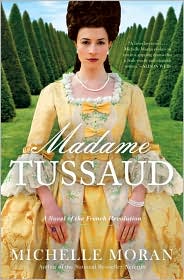
The world knows Madame Tussaud as a wax artist extraordinaire . . . but who was this woman who became one of the most famous sculptresses of all time? In these pages, her tumultuous and amazing story comes to life as only Michelle Moran can tell it. The year is 1788, and a revolution is about to begin.
Smart and ambitious, Marie Tussaud has learned the secrets of wax sculpting by working alongside her uncle in their celebrated wax museum, the Salon de Cire. From her popular model of the American ambassador, Thomas Jefferson, to her tableau of the royal family at dinner, Marie’s museum provides Parisians with the very latest news on fashion, gossip, and even politics. Her customers hail from every walk of life, yet her greatest dream is to attract the attention of Marie Antoinette and Louis XVI; their stamp of approval on her work could catapult her and her museum to the fame and riches she desires. After months of anticipation, Marie learns that the royal family is willing to come and see their likenesses. When they finally arrive, the king’s sister is so impressed that she requests Marie’s presence at Versailles as a royal tutor in wax sculpting. It is a request Marie knows she cannot refuse—even if it means time away from her beloved Salon and her increasingly dear friend, Henri Charles.
As Marie gets to know her pupil, Princesse Élisabeth, she also becomes acquainted with the king and queen, who introduce her to the glamorous life at court. From lavish parties with more delicacies than she’s ever seen to rooms filled with candles lit only once before being discarded, Marie steps into a world entirely different from her home on the Boulevard du Temple, where people are selling their teeth in order to put food on the table.
Meanwhile, many resent the vast separation between rich and poor. In salons and cafés across Paris, people like Camille Desmoulins, Jean-Paul Marat, and Maximilien Robespierre are lashing out against the monarchy. Soon, there’s whispered talk of revolution. . . . Will Marie be able to hold on to both the love of her life and her friendship with the royal family as France approaches civil war? And more important, will she be able to fulfill the demands of powerful revolutionaries who ask that she make the death masks of beheaded aristocrats, some of whom she knows?
Spanning five years, from the budding revolution to the Reign of Terror, Madame Tussaud brings us into the world of an incredible heroine whose talent for wax modeling saved her life and preserved the faces of a vanished kingdom.
Michelle Moran was born in the San Fernando Valley, CA. She took an interest in writing from an early age, purchasing Writer's Market and submitting her stories and novellas to publishers from the time she was twelve. When she was accepted into Pomona College she took as many classes as possible in British Literature, particularly Milton, Chaucer, and the Bard. Not surprisingly, she majored in English while she was there. Following a summer in Israel where she worked as a volunteer archaeologist, she earned an MA from the Claremont Graduate University.
Michelle has traveled around the world, from Zimbabwe to India, and her experiences at archaeological sites were what inspired her to write historical fiction. A public high school teacher for six years, Michelle Moran is currently a full-time writer living in California with her husband.
A: My interest in Marie Tussaud began on my very first trip to London. Like thousands of tourists before me, I had decided that I wanted to visit the famous wax museum, Madame Tussauds. At the time, I knew almost nothing about the woman behind the name, but as I passed through the exhibition, I began to piece together what would ultimately prove to be a fascinating story. In the first wax tableau I came across, Marie Tussaud had modeled Queen Marie Antoinette with her husband and children. They looked young and happy, dressed in lavish court gowns and silk culottes. In another tableau, the mistress of King Louis XV lay sprawled on a couch, her blonde hair tumbling down her shoulders. Clearly, Marie Tussaud had been interested in modeling the celebrities of her day. Some she would have sculpted from memory, while many she would have met and modeled in person. Marie’s art had obviously gained her access to some of the highest circles in French society. But in a third tableau, a different part of Marie Tussaud’s life emerged. Dressed in a black gown and dirtied apron, a young Marie could be seen holding up a lantern in the Madeleine Cemetery. The Revolution had begun, and she was searching through a pile of severed heads – all victims of Madame Guillotine. Immediately, I wanted to know what was she doing in that cemetery. Whose heads were they, and did she know those people? When I learned what Marie Tussaud went through during the French Revolution – who she’d met, where she’d gone, and what she’d seen – I knew I would someday tell her story.
Q: Why does history tend to remember the French Revolution as being successful?
A: Probably because it did exactly what its leaders intended, which was to deal a devastating blow to the aristocracy. But very soon after the overthrow of the monarchy, France’s new government became obsessed with idea of rooting out Royalists. A fever like that of the Salem Witch Trials gripped France, and neighbor began turning on neighbor, accusing each other of being royalists. And it didn’t take much to be sentenced to the guillotine. By 1793, all a person had to do was whistle the wrong tune or disrespect a liberty tree (saplings planted in the name of “liberty”) to be accused of endangering the nation. By the end of the French Revolution, more than five hundred thousand French citizens had been killed, most of them commoners.
Q: How did you go about researching Madame Tussaud?
A: I began with a trip to France, where nearly all of the novel takes place. Once there, I tried to visit the locations Madame Tussaud herself would have seen. Some—such as the Bastille—no longer exist, but there are others—Versailles being the sublime example—where a great deal of 18th century life has been preserved. After my trip, I did as much research as I could in libraries. Finally, anything I couldn’t find in books I tried to discover through email conversations with some very generous French historians.
Q: What is the most interesting fact you learned while researching MadameTussaud?
A: That in 18th century France, most people went to street dentists when they had a toothache. These dentists would sit at a table laid out with various tools, and their unfortunate patients would have their teeth extracted right there, in the dirty street. After the extraction, the patient could sell his tooth (or teeth, if he was unlucky) to the dentist, who would then sell it to people like Marie Tussaud for her wax models. I know… creepy and disturbing!
Q: In your research about Marie Antoinette, did you come away feeling sorry for Queen Marie Antoinette? A: Yes. I think the queen was as much a victim of circumstance as she was her own naiveté. While it’s true that she held lavish balls in Versailles and spent a fortune on gowns, this really wasn’t anything new for the monarchy. The difference was that it was Marie Antoinette, and not the king, who was doing the spending. The resentment and jealousy which built up around the queen having access to her husband’s money earned her some powerful enemies at court. Meanwhile, the commoners were growing resentful as well. Yet the entire royal family’s expenditures were actually a small fraction of the nation’s budget, and whenever Marie Antoinette tried to economize, the courtiers who counted on her favors would raise a hue and cry. Various nobles had grown accustomed to the extra money they could earn from selling the dresses she had already worn or the accessories which had been ordered for her (often far more than she actually needed or used). These privileges were jealously guarded in Versailles, and this meant that the queen was “damned if she did, and damned if she didn’t.”
Q: Why are we still interested in Madame Tussaud 250 years after her birth?
A: I think the fascination with Madame Tussaud comes from the fact that the life she created was as intricate and mystifying as her artistry itself. Here was a woman who was asked to tutor the king’s sister, yet she managed to keep her head during the Reign of Terror when women were being imprisoned for nothing more than wearing the wrong color. She navigated two very different worlds – the court of Versailles and the streets of Paris - and against all odds, lived to tell the tale. And through it all, it was her artistry that saved her. Today, with digital cameras available to capture everything around us, you would think it would be difficult to become enthusiastic about seeing a person’s likeness reproduced in wax. But there is something compelling about waxworks, particularly those done at the various Madame Tussauds around the world. Perhaps it’s the thrill of pretending to photograph yourself next to a celebrity, or getting to pose with Henry VIII “in the flesh,” that keep customers coming back. Or maybe it’s the eerie and arresting vision of a lifeless object that so closely mimics someone’s humanity that people relate to. Whatever it is, I think Madame Tussauds will be a major draw even in another two hundred and fifty years.
Q: If Madame Tussaud were alive today, would she be happy to see that her wax museums have expanded not only throughout Europe, but now the world? A: I think Marie Tussaud would be ecstatic. Having grown up on the Boulevard du Temple surrounded by actresses and showmen, Marie was taught from a very young age that publicity was the difference between staying in business and having to sell your teeth in order to buy bread. Today, the Madame Tussauds wax museums do a wonderful job of finding new subjects to model, and the public unveilings of their new wax figures would have absolutely delighted Marie. A part of me wants to say, “If only Marie could see her museum now,” but something tells me she wouldn’t be surprised at all by how popular her exhibition has become.
My Thoughts
When she walks through the door of my exhibition, everything disappears: the sound of the rain against the windows, the wax models, the customers, even the children.
Town/Location/Environment:
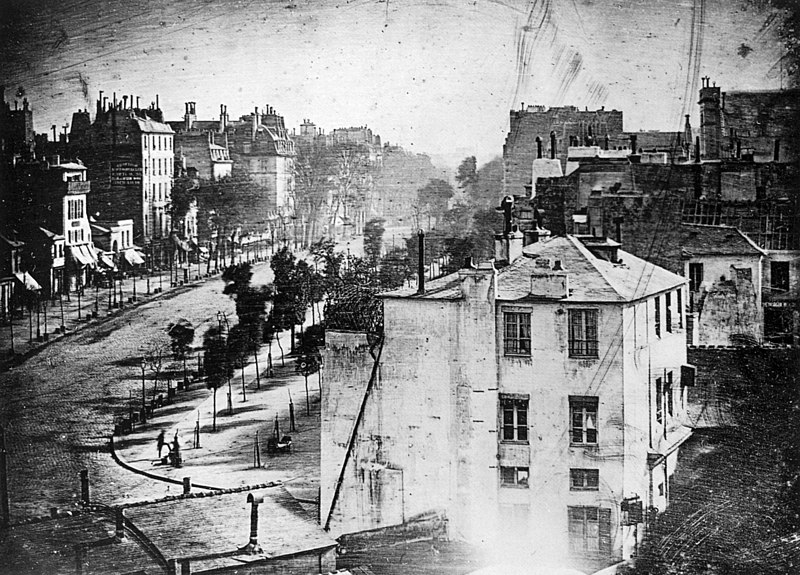
The majority of the book takes place in Paris, and much of it occurs on the Boulevard du Temple, where Madame Tussaud (then known as Marie Grosholtz) lived and worked at her first wax museum with her family. I thought that this photo, which author Michelle Moran introduced to her readers to at the end of her book, was a suitable photo to represent the times. The photo was taken by Daguerre in 1838 of the Boulevard du Temple (a few decades after Marie had moved away), and is purported to be the first photo of a human being. As described in Wikipedia:
The purportedly first picture of a living person. The image shows a busy street, but due to exposure time of more than ten minutes, the traffic was moving too much to appear. The exception is the man at the bottom left, who stood still getting his boots polished long enough to show. Look closely and you will also see another man sitting on a bench to the right reading a newspaper. Also in the upper left hand side you can also see another man standing under the awning of the 3rd building from the left. What looks to be a woman standing under the street lantern at 10 o'clock from the man getting his shoes shined and another one in the big white building, 1st row 3rd window down.
This is where it all began for Madam Tussaud's, and where much of her story takes place.
This story covers the life of Madame Tussaud through the turbulent years of the French Revolution. We find Madame Tussaud living on the Boulevard du Temple with her mother and "uncle" Curtius (he is really her mother's lover, and like a father to Marie, but as her mother is not capable of legally marrying Curtius, they live together without the benefit of marriage).
Curtius is a respected wax sculptor and has taught Marie everything she knows about the craft and business, and they have grabbed the attention of the king and queen, who visit the "salon" (as they call the wax museum) , bringing great excitement to the area and lots of attention and business to the salon in the days following the royal's visit.
Marie's three brothers are all members of the Swiss Guard, and sworn to protect the king. Due to line of work that Marie and Curtius are in, the family has varied associations and their home is often host to gatherings of key political figures like Robespierre, Lafayette, Duc d'Orleans (cousin of King Louis XVI), and Marat.
Madame Tussaud lives next door to Henri and Jacques Charles, brothers who are scientists and use their home to perform experiments. Henri and Jacques are good friends of the family, but Henri eventually makes it clear to Marie that he is in love with her. His courtship of her and his patience with her while she delays their romance is sweet and touching.
The story takes you through the French Revolution, from the grumblings of discontent to the violent clashes and the following "inquisition" reminiscent of the Salem witch trials. Friends turn on friends, neighbors on neighbors. Robespierre releases lists of "enemies" of the revolution, most of which initially are royals. People who make it on the list are targeted for arrest and often execution by guillotine, or are attacked and executed by mobs of supporters of the revolution. Later on, those that make it on the "list" are most often commoners, and in fact during the "Reign of Terror" (as it was called), the commoners suffered worse than anyone.
I found it really bizarre, and was totally surprised to learn, that the revolutionaries even adopted new calendars, new methods for counting years, new fashions and holidays, and even banned religion altogether, and began imprisoning people for something as minor as failing to wear a cockade to identify them as a "Citizen" (people who supported the revolution). This was liberty? As Michelle states in her "Historical Note" at the end of the book:
In their fanaticism to spread liberty and equality, the revolutionaries created a tyranny.
My own family are Huguenots, so I've been raised with stories of how my ancestors endured religious persecution in France. However I had no idea what occurred during the French Revolution, and was totally taken aback.
I do not seek out the historical fiction genre. I often find it a little bland for my tastes. However, this being my second Michelle Moran historical fiction book, I have found the author does such a great job of bringing characters to life and recreating the times and events surrounding their lives. Each time I finish one of her books, I'm left hungering for another!
My final thoughts: Engaging characters, disturbing images, shocking events. Love, family, loss. This book has it all. If you love historical fiction (and, heck, even if you don't!), pick this one up right away!
My Rating: 8.5 out of 10
Disclosure:
I received a copy of this book to review from the author, in exchange for my honest opinion. I was not financially compensated in any way, and the opinions expressed are my own and based on my observations while reading this novel. Thanks so much to Michelle Moran for surprising me with this book!
Princess Alais of France travels to England to marry Richard the Lionhearted, the son of King Henry II, armed only with her dowry, the valuable Vexin. When Alais arrives in the land of her father’s enemies, she is welcomed by the beautiful and powerful queen, Eleanor of Aquitaine. Eleanor, the richest and most influential woman in Europe, sees a kindred soul in the young French princess. Intrigued by the girl’s strength and fire, Eleanor adopts Alais as her protégée, teaching the girl what it takes to be a woman of power in a world of men. But Eleanor and Alais’ love for each other is threatened when the capricious and imperious King Henry meets the lovely young princess. Fascination with the king draws Alais deep into political intrigue, and she soon discovers what Eleanor is prepared to do to retain her position as queen. Alais, the one-time pawn, takes ruthless action of her own, as the two women become rivals both for the king’s love and the throne of England itself.
About the Author
Christy English has a bachelor's degree in history from Duke University. The Queen's Pawn is her first novel. Christy describes herself:
I am a writer of historical fiction centering on Eleanor of Aquitaine, Alais of France, and the Plantagenets of the 12th Century. Look for my novel THE QUEEN’S PAWN from the New American Library, an imprint of Penguin.
My second novel, about Eleanor of Aquitaine’s marriage to Louis VII of France, TO BE QUEEN, will be published by the New American Library in April 2011.
Princess Alais of France, the daughter of King Louis of France, is brokered in marriage to Prince Richard the Lionheart, son of King Henry and Louis' ex Eleanor of Aquitaine. Alais is only 9 years old at the time, but she is sent away to live in a convent in England until she is of marriageable age.
At fourteen years of age, Alais is brought to Winchester Castle to meet her betrothed, and to be presented to the King and gain his approval for the marriage. She is under the wing of Eleanor of Aquitaine, who becomes something of a mother to Alais, and the only one that Alais has ever known, her own mother having died during her birth.
Soon after Alais turns against her adoptive mother Eleanor and betrothed Richard, and turns towards King Henry, becoming his mistress.
This story was pretty well-developed, the characters of Alais and Eleanor were relatively well fleshed out. Probably the main issue is that, as I get back into reading and try different genres, I find that historical fiction is probably not the best genre for me. I always find myself a little bored. It just doesn't give me that "edge of my seat" thrill that I seek when reading. But that is no fault of the author.
So I would say that if you like historical fiction, then you would probably really enjoy this story and should give it a go. Me? I enjoyed it, but I didn't love it.
My Rating: 7 out of 10
My thanks to author Christy English for a free copy of The Queen's Pawn in exchange for my honest review.