The women of Freesia Court are convinced that there is nothing good coffee, delectable desserts, and a strong shoulder can’t fix. Laughter is the glue that holds them together—the foundation of a book group they call AHEB (Angry Housewives Eating Bon Bons), an unofficial “club” that becomes much more. It becomes a lifeline. Holding on through forty eventful years, there’s Faith, a lonely mother of twins who harbors a terrible secret that has condemned her to living a lie; big, beautiful Audrey, the resident sex queen who knows that with good posture and an attitude you can get away with anything; Merit, the shy doctor’s wife with the face of an angel and the private hell of an abusive husband; Kari, a wise woman with a wonderful laugh who knows the greatest gifts appear after life’s fiercest storms; and finally, Slip, a tiny spitfire of a woman who isn’t afraid to look trouble straight in the eye.
This stalwart group of friends depicts a special slice of American life, of stay-at-home days and new careers, of children and grandchildren, of bold beginnings and second chances, in which the power of forgiveness, understanding, and the perfectly timed giggle fit is the CPR that mends broken hearts and shattered dreams.
Paperback, 512 pages Published March 29th 2005 by Random House Publishing Group (first published January 1st 2003) ISBN 0345475690 (ISBN13: 9780345475695)
About the Author from Goodreads
Lorna Landvik is a mother of two and wife of one. She is the author of eight novels, including the best-selling ANGRY HOUSEWIVES EATING BON BONS, PATTY JANE'S HOUSE OF CURL and OH MY STARS. Also an actor and playwright, Lorna has appeared in many stage productions. She is a new and passionate neophyte to the practice of yoga, which is a fine antidote to her long established practice of lounging.
A Fuller Brush salesman had the unfortunate task of trying to sell his wares to the women of Freesia Court during the fifth day of a March cold snap.
This is the story of five women who form a book club, following the women over decades of friendship.
Faith is married to husband Wade, and with twins- a girl and a boy. Faith is grounded and sensible, but full of secrets and living a lie (or series of lies).
Audrey and husband Paul appear to have the perfect life. With two boys and an attentive husband, Audrey thinks that having a great sex life equates a good marriage. Later she becomes a person of more depth.
Merit is the beautiful daughter of a Lutheran minister. Most people don't see beyond her beauty, and assume that there is nothing more to her. But there is a lot going on in her life and with her husband Eric.
Slip is a fiery, fearless, opinionated activist, and her husband Jerry stands by her in everything.
Kari is a widow, her husband Bjorn having died in his forties, before they had any children. She is a seamstress, home designer and a favorite of her nieces and nephews. There is something stabilizing and grounded about Kari.
There’s something about Kari that makes me feel calm-- after listening to her I feel like I’ve drunk a warm glass of milk. (p. 48)
This story is character-driven, with full, well-fleshed out characters. But that is not to say that the plot plays second-fiddle. This story is equally plot and character driven, and it covers the gamut. Childhood heartbreak, unhappy marriages, domestic abuse, substance abuse, the horrors of war, the pain and joys of parenthood. It has it all.
My biggest issue was with Faith's letters. Faith writes regular letters to her deceased mother throughout the book, and these letters became my least favorite part of the story. Accusatory, bitter, morose, they dwell on the past, and Faith doesn't seem to appreciate how lucky she is to have what she has.
You never know what little tidbits of knowledge you'll pick up at a book club discussion. I can't remember of which topic from the book we were discussing, but one woman said that someone she knew had five miscarriages. The doctor told her to drink a beer every day with the next pregnancy, as it suppresses contractions, and she carried that baby to term!
Someone in the book club also pointed out that more time was given to developing the gay couple than in addressing the divorce of one of the characters, and how she got the strength to follow through with it. I have to say that I agree. The gay couple weren't really integral to the story and never really tied in with the storyline. They felt "superfluous", as if they were the "token gay couple" in the story. So one of my main complaints with the book is that too much time was spent on inconsequential things and people that didn't really add to the story.
But I did enjoy the writing, and some of the stories the characters would tell. At one point, one of the characters relayed a discussion with a professor, and I enjoyed the analogy...
“...And then there’s Professor Emory-- he teaches the theology class I’m taking at night school-- because one day he compared religions to a baseball team, with Catholicism as the catcher, crouched down and willing to take the most punishment, giving secret signals; Baptists as the umpires, always judging who’d erred; Buddhism as the pinch hitter, who would hit a home run if he can just get up to bat, but if he only gets to warm the bench, that’s fine too...” (p. 117)
My final word: I enjoyed this book. Our book club had mixed responses to it. Many gave it about a C. I gave it a B+. It had both serious moments and humorous moments, allowing you to watch the development of the character's lives over decades. I would recommend this one.
When retired Major Pettigrew strikes up an unlikely friendship with Mrs. Ali, the Pakistani village shopkeeper, he is drawn out of his regimented world and forced to confront the realities of life in the twenty-first century. Brought together by a shared love of literature and the loss of their respective spouses, the Major and Mrs. Ali soon find their friendship on the cusp of blossoming into something more. But although the Major was actually born in Lahore, and Mrs. Ali was born in Cambridge, village society insists on embracing him as the quintessential local and her as a permanent foreigner. The Major has always taken special pride in the village, but will he be forced to choose between the place he calls home and a future with Mrs. Ali?
Hardcover, 358 pages Published March 2nd 2010 by Random House (first published 2010) ISBN 0385668643 (ISBN13: 9781400068937)
I have lived in America for over twenty years. I am a long-time and proud resident of Brooklyn, New York, though I have also spent some time living in the Washington DC area. However, I was born in England, and when I was a teenager, my family achieved the English dream - to move to a house in the country.
East Sussex, with its sleepy villages, medieval smuggling towns, and unique pebble-bank shores is my vision of 'home.' My family lives near Rye, a 14th Century smuggling port on a cobbled hill, from which the sea receded long ago. It is marooned in the eerie landscape once home to smugglers, yet clings to its designation as a member of the Cinque Ports. Close by are the seaside towns of Hastings and Eastbourne and to the west, the Downs swell up into a ridge of grassy hills topped by the hundred mile trail known as the South Downs Way. It is literary country - Henry James at Lamb House, Rye; Kipling at Batemans, Burwash; Virginia Woolf at Monk's House, near Lewes - and this heritage was always a great inspiration to me.
As a young woman, I could not wait to go to college in London, or to move three thousand miles away from home to America. Yet I have always carried with me a longing for England that will not fade. I think this dichotomy - between the desire for home and the urge to leave - is of central interest to my life and my writing. —Helen Simonson
Major Pettigrew was still upset about the phone call from his brother's wife and so he answered the doorbell without thinking.
Town/Location:
The story takes place in the fictionalized village of Edgecombe St. Mary, which would probably look something like the traditional village scene below.
Major Pettigrew is having a difficult time. His brother just died, the gun he has always expected to inherit has gone to someone else, and he's at his wit's end with his self-centered son. The local store owner Mrs. Ali is having a difficult time herself. She is viewed in her Pakistani culture as having reached an age when she needs to hand things over to the next generation to carry on, and this isn't something about which she is very happy.
This was a charming story. It wasn't an exciting story or an especially challenging story, but it was quaint and charming.
Most of the main characters were very likable, and people I would actually like to know in real life. Major Pettigrew can be a bit surly at times, but I happen to like that about him. Mrs. Ali is warm and thoughtful, and carries herself with great poise. Grace is the sweetest and most forgiving of women. The Major’s son Roger is a grown spoiled brat, snobbish and quite a bit self-centered and inconsiderate. Sandy is a strong and independent American woman whom the Major's son brings home, and initially grating to a proper Englishman, she has a softness that eventually wins over the Major.
The Major and Mrs. Ali find themselves in a similar position. Mrs. Ali finds she is expected by her culture to give her life over to the next generation (in her case, this being her nephew), while the Major is similarly expected by his son to do the same and hand over what is precious to him.
This story showcases the underpinnings of a small village, the bigotry that can exist anywhere, and the difficulties of the older generation who are viewed as being at the end of their lives. However it also shows how pure love can be when experienced at an advanced age. In fact, someone in my book club stated that the courtship period in a relationship seems to last longer later in life. There are no kids to distract you, and more time to focus on one another. And another said that her teenage son had remarked to her that, thanks to a world of technology that offers constant connection, his generation doesn't get to experience the wonder of "anticipation" early on in a relationship. We all know that excitement-- the butterflies in the stomach, the restless impatience-- of waiting and anticipating seeing a new love again, or having the phone ring and hearing their voice. That sense of anticipation has been lost to the new generation. More's the pity.
Another undercurrent in the book is the racism and classism that exists in Britain and many places around the world. Major Pettigrew, the son of a British soldier, was born in Lahore, Pakistan. Mrs. Ali is of Pakistani descent, yet was born in Britain. However it is Mrs. Ali that is viewed as the foreigner and looked down upon, while Major Pettigrew is a respected man of class and wealth.
Of minor note, the book does make mention of Huguenots, which (being a Huguenot), is something that I always note:
“It says, ‘Mark Salisbury married this day to Daniela de Julien, late of La Rochelle.’ This is the first record of Huguenots settling in the village.” (p. 32)
A couple of other quotes that I noted:
“I don’t believe the greatest views in the world are great because they are vast or exotic,” she said. “I think their power comes from the knowledge that they do not change. You look at them and you know they have been the same for a thousand years.” (p. 108)
She raised an eyebrow in mock surprise, hugging the boy hard to her ample poncho. The boy whimpered under his breath and the Major hoped he was being comforted rather than suffocated. (p. 193)
I read the e-book edition, but I have seen the book cover and love it! It actually took a while for me to notice that it was not a man and woman embracing, but only coats and hats hanging on a coat rack. Clever!
The book is written in manageable chapters of 12-18 pages, allowing someone like me who reads pretty slowly to read at least a chapter most days.
My final word: A charming story with charming characters. This wasn't a book that I loved, but one that I did like quite well.
Years ago, Marina Singh traded the hard decisions and intensity of medical practice for the quieter world of research at a pharmaceutical company, a choice that has haunted her life. Enveloping herself in safety, limiting emotional risk, she shares a quiet intimacy with her widowed older boss, Mr. Fox, and a warm friendship with her colleague Anders Eckman. But Marina's security is shaken when she learns that Anders, sent to the Amazon to check on a field team, is dead-and Mr. Fox wants her to go into the jungle to discover what happened.
Plagued by trepidation, yet propelled by her sense of duty, Marina embarks on an odyssey into the unknown, down into the Amazonian delta, deep into the dense, insect-infested jungle to find answers from the company's research team. Led by the formidable Dr. Annick Swenson, the scientists are looking into the development of a new drug that could have a profound impact on Western society. But the team has been silent for two years and the daunting Dr. Swenson does not like interlopers inserting themselves in her work, as Marina well knows. The eminent and fiercely uncompromising doctor was once her mentor, the woman she admired, emulated, and feared. To fulfill her mission, Marina must confront the ghosts of her past, as well as unfulfilled dreams and expectations-a journey that will force her to make painful moral choices and take her deep into her own heart of darkness.
A rich narrative dense with atmosphere and full of deeply realized characters, packed with amazing twists and surprises-encounters with an anaconda, cannibals, death, and birth-State of Wonder is Ann Patchett's most enthralling and confident novel, a tale that will leave readers in their own state of wonder, examining their own values and beliefs.
Hardcover, 353 pages Published June 7th 2011 by HarperCollins Publishers (first published 2011) ISBN 0062049801 (ISBN13: 9780062049803) http://www.bloomsbury.com/State-of-Wonder-Ann-Patchett/
Ann Patchett is the author of five novels: the New York Times bestselling Run; The Patron Saint of Liars, which was aNew York Times Notable Book of the Year; Taft, which won the Janet Heidinger Kafka Prize; The Magician’s Assistant; and Bel Canto, which won the PEN/Faulkner Award, the Orange Prize, the BookSense Book of the Year, and was a finalist for the National Book Critics Circle Award. She is also the author of two works of nonfiction: theNew York Times bestselling Truth & Beautyand What Now? Patchett has written for many publications, including the Atlantic Monthly, Harper’s Magazine, Gourmet, the New York Times, Vogue, and the Washington Post. She lives in Nashville, Tennessee.
The news of Anders Eckman’s death came by way of Aerogram, a piece of bright blue airmail paper that served as both the stationery and, when folded over and sealed along the edges, the envelope.
This story begins in Minnesota, but fairly quickly transitions to Brazil and the heat of the Amazon.
Dr. Anders Eckman is reported dead in the Amazon after being sent there to get a status update from Dr. Swenson, who has been working in the Amazon jungle on a fertility miracle drug. Dr. Eckman's office co-worker Dr. Marina Singh is sent down to the Amazon to find out what she can about his death, and to pick up Dr. Eckman's mission where he left off.
Mr. Fox is Dr. Singh's boss, and the one responsible for sending both Eckman and Singh down to the Amazon. There is something a little off-putting about him. Detached, self-centered, only thinking about the science and with little apparent regard for the safety of the people under him, but yet not a really bad guy. Dr. Marina Singh is capable, but full of self-doubt. Starting with a mishap during a surgery when she was a resident at John Hopkins under the tutelage of Dr. Annick Swenson, Marina abandoned her promising career in obstetrics and got into the pharmacological field instead. Now she is being sent to the Amazon to confront her old nemesis.
Dr. Annick Swenson is all science. Think a female version of Sean Connery's character in the movie Medicine Man. Socially inept, self-centered and tactless, she is one of those people who believes that the ends justify the means and has no problem doing questionable things for the "greater good".
After learning of her co-worker's death, Marina is convinced by Anders wife to go down to the Amazon to find out what happened to him and where his body is, and her boss Mr. Fox wants her to find out where Dr. Swenson is in her research on a fertility treatment that has 70-year-old women giving birth.
While in Brazil, Marina meets Milton, a sort of Brazilian "jack-of-all-trades". He is a driver, messenger, and a man who can get things done. Handsome, charming, always ready to rescue Marina in times of trouble, the ladies in my book club all agreed that he was the man of our dreams!
Attempting to track down Dr. Swenson, Marina encounters Jackie and Barbara Bovender, who play the "gatekeepers" for Dr. Swenson, blocking all access to her. These two were an odd couple. Bohemian beauties described as looking alike, they had my book club wondering whether they were brother and sister or husband and wife. I don't think that the book ever makes it clear.
This book was an odd one for me. I didn’t want to put it down, wanting to turn the page and discover what would happen next, and yet I was left feeling a little...melancholy. That’s the best way I can describe it. This was a good story, well-written, but it wasn’t a rip-roaring fun ride. It was emotional and thought-provoking, but a little sad- always a little sad. There were never really any “giddy” moments.
Once the book shifted to the Amazon, it quickly reminded me of the movie Medicine Man, and that familiarity was continually reinforced as I continued to read. The book even mentions the candiru, a fish that will swim up the urethra of river swimmers, which is likewise the subject of a conversation in the movie Medicine Man.
I had an issue with the sub-plot of the book related to fertility, but they did sort of address my concerns nearer the end of the book. And we agreed in the book club that you really must approach this book as something of a fairytale. There is a lot of "suspension of disbelief" required with this book.
You know, I tried my hand at writing recently, and I discovered how difficult it is. I can do dialogue. I can outline a plot. But I can’t really “write”. There is something that true writers can do that bring realism to a story. It’s the little details. Like when the author mentions Marina answering the phone in the middle of the night, and sitting up in bed, she reaches down to adjust the bottom of her nightgown caught underneath her. Such a minor detail, but it brings such realism to the story. Every woman knows what that is like. We’ve all become tangled in our nightgowns. But would I ever think to include such a personal little tidbit in a piece I was writing? Probably not. I really loved these little bits that drew me closer to the characters and made them my friends-- or myself. And sometimes her lyrical descriptions were just gorgeous...
“The city was breaking her down along with the Lariam, her sense of failure, her nearly mad desire to be home in time to see the lilacs. But then the orchestra struck a note that brought her back to herself. Every pass of the cellists’ bows across the cellos’ strings scraped away a bit of her confusion, and the woodwinds returned her to strength. While she sat in the dark, Marina started to think that this opera house, and indeed this opera, were meant to save her.” (p. 124)
I liked the book cover. It is reminiscent of a antique map used by discovers, and is very fitting for a book about the Amazon.
My final word: This book is not for someone who insists on an ending all tied up with a neat little bow. It leaves the ending much to your interpretation, and I actually found that I enjoyed the first 3/4 of the book much more than the ending. So the first half of the book I loved, and the last half I just liked. But I liked it enough to want to try Ann Patchett again, as this is my first book written by her.
Synopsis The Tragedy of Arthur is an emotional and elaborately constructed tour de force from bestselling and critically acclaimed novelist Arthur Phillips, “one of the best writers in America” (The Washington Post).
Its doomed hero is Arthur Phillips, a young man struggling with a larger-than-life father, a con artist who works wonders of deception but is a most unreliable parent. Arthur is raised in an enchanted world of smoke and mirrors where the only unshifting truth is his father’s and his beloved twin sister’s deep and abiding love for the works of William Shakespeare—a love so pervasive that Arthur becomes a writer in a misguided bid for their approval and affection.
Years later, Arthur’s father, imprisoned for decades and nearing the end of his life, shares with Arthur a treasure he’s kept secret for half a century: a previously unknown play by Shakespeare, titledThe Tragedy of Arthur. But Arthur and his sister also inherit their father’s mission: to see the play published and acknowledged as the Bard’s last great gift to humanity. . . .
Unless it’s their father’s last great con.
By turns hilarious and haunting, this virtuosic novel—which includes Shakespeare’s (?) lost King Arthur play in its five-act entirety—captures the very essence of romantic and familial love and betrayal. The Tragedy of Arthur explores the tension between storytelling and truth-telling, the thirst for originality in all our lives, and the act of literary mythmaking, both now and four centuries ago, as the two Arthurs—Arthur the novelist and Arthur the ancient king—play out their individual but strangely intertwined fates.
About the Author
Arthur Phillips was born in Minneapolis and educated at Harvard. He has been a child actor, a jazz musician, a speechwriter, a dismally failed entrepreneur, and a five-time Jeopardy! champion.
His first novel, Prague, was named a New York Times Notable Book, and received The Los Angeles Times/Art Seidenbaum Award for best first novel. His second novel, The Egyptologist, was an international bestseller, and was on more than a dozen “Best of 2004” lists. Angelica, his third novel, made The Washington Post best fiction of 2007 and led that paper to call him "One of the best writers in America." The Song Is You was a New York Times Notable Book, on the Post's best of 2009 list, and inspired Kirkus to write, "Phillips still looks like the best American novelist to have emerged in the present decade."
His fifth book, The Tragedy of Arthur, was published April, 2011, to critical acclaim, including being named a New York Times Notable Book.
The play taken from that book received its world premiere reading at New York's Public Theater in 2011 and is being developed for a full stage production.
His work has been published in twenty-seven languages, and is the source of three films currently in development with Endgame Entertainment, Focus Films, and Cinetic.
He is also creating a series for HBO/Pretty Matches Productions, and has two other television pilots in development.
He lives in New York with his wife and two sons. Check out his website here Check out his profile on Jeopardy here Find him on Twitter
My Thoughts
I have never much liked Shakespeare. I find the plays more pleasant to read than to watch, but I could do without him, up to and including this unstoppable and unfortunate book. I know that is not a very literary or learned thing to confess, but there it is.
Normally "My Thoughts" would consist of my review of the book read. However I could not finish this one. I only made it about 47 pages into this book. And, just to lend more strangeness to this story, at 47 pages in I was still reading the "introduction" to the book. This book is almost 370 pages long, of which 250+ pages is an "Introduction" by the author, and the remaining 120 pages is the "lost play" of Shakespeare.
The "introduction" is...I don't know. I couldn't get through it. It is a self-absorbed man's ramblings of his childhood and past, and everything leading up to...well, like I said, I couldn't get through it. I'm still not sure what it led up to. The book ends with a play that is supposed to have been written by Shakespeare, but there seemed to be confusion among the book club members whether the play even really existed. This is like watching one of those movies about a movie about a movie. It's hard to sort out what is reality and what is fiction. What is the actual past of the author, and what is the fictional life of a character lost in his own head?
One good thing that came from this book was that our book club had a very interesting and lively discussion of the book and author. Here are a few things that came out of our discussion:
Some said they felt as if the author was making fun of the reader, seeing how much he could lure people into this farce that was a parody of a memoir.
The line between reality and fantasy is totally blurred in this book. You simply don't know how much is real, how much of it is truly a memoir of the author's life, and how much is complete fantasy.
He has a creepy and almost incestuous relationship with his twin sister. (In an attempt to explain their relationship, he states on page 47: "And all along I dreamt of being Dana's...what? Not her lover-- this is not a report of rank incest-- but I dreamt of being something indescribably close, perfectly joined, soulmated beyond the possibility of any rupture or misunderstanding.")
Someone said that the book is being made into a play.
Many said that they aren't stupid, but they felt stupid reading this book, because they just didn't get it. This book made it onto the bestseller's list, had fantastic reviews, and everyone in our club found themselves reading it and thinking, "Am I just stupid? Because I just don't get it!"
One woman said that throughout the book she kept thinking that each of us, if you were to break down our lives into our triumphs and tragedies, would be worthy of a Shakespearean play.
One girl said that she read the book at work, and she finally put the book down and said she'd rather work!
So the book didn't go over well with our book club, but we all really loved the discussion regarding the book and the author. Many in the club felt that someone may enjoy this book more if they really love Shakespeare. I was doubtful of this, as I do actually like some Shakespeare, until one of the members (the same one who made the remark about all of us being worthy of being in a Shakespearean play) explained to everyone a lot of background on Shakespeare, his life, and the way he used names in his plays (i.e. Juliet being a "jewel", while Rosalind was "beautiful yet thorny"). It made you kind of wish you knew these details about Shakespeare going into this book, and realizing that you may have picked up on little details if you had.
A couple of our book club members enjoyed the book. No one really loved it, but I think a couple rated it a "B". Most of the members didn't finish the book. One girl said that she absolutely hated it and thought it was the worst book she'd ever tried to read (she made it through page 51).
My personal take on this book? When I was trying to think of how to describe this book, what immediately came to mind was "tedious". Trudging through the minutia of his childhood, having to reside in his brain, as he (Is "he" just a character? Or the actual author? We don't know!) is self-absorbed and lives in his head. He is the main player and everyone is in his life is secondary and tertiary characters, or as someone in the club said, "They are all just living on the periphery of his world." In his world, all the other characters are inconsequential. The other words that came to my mind when describing this book were languid, rambling, and just plain boring.
But don't let this stop you! This book had a lot of great reviews. The critics loved it! Particularly if you love Shakespeare, go ahead and give this one a shot. You may love it!
Meet Denver, a man raised under plantation-style slavery in Louisiana in the 1960s; a man who escaped, hopping a train to wander, homeless, for eighteen years on the streets of Dallas, Texas. No longer a slave, Denver's life was still hopeless-until God moved. First came a godly woman who prayed, listened, and obeyed. And then came her husband, Ron, an international arts dealer at home in a world of Armani-suited millionaires. And then they all came together.
But slavery takes many forms. Deborah discovers that she has cancer. In the face of possible death, she charges her husband to rescue Denver. Who will be saved, and who will be lost? What is the future for these unlikely three? What is God doing?
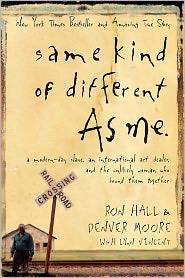
Same Kind of Different As Me is the emotional tale of their story: a telling of pain and laughter, doubt and tears, dug out between the bondages of this earth and the free possibility of heaven. No reader or listener will ever forget it.
Pub. Date: March 2008 Publisher: Nelson, Thomas, Inc. Format: Paperback , 256pp ISBN-13: 9780849919107 ISBN: 084991910X
Denver was born in rural Louisiana in January 1937, and after several tragic events went to live on a plantation in Red River Parish with his Uncle James and Aunt Ethel, who were share croppers.
Sometime around 1960, he hopped a freight train and began a life as a homeless drifter until 1966 when a judge awarded him a 10 year contract for hard labor at the Louisiana State School of Fools, aka, Angola Prison!
According to Denver, he went in a man and left a man and received a standing ovation from prisoners in the yard as he walked out of there in 1976. For the next 22 years he was homeless on the streets of Fort Worth, Texas. However, there were a few times after a brush with the law, he'd ride the rails visiting cities and hobo jungles across America, sampling regional cuisine like Vienna sausage with fellow passengers.
In 1998, "He never met Miss Debbie," Miss Debbie met him and his life was changed forever.
Today, he is an artist, public speaker, and volunteer for homeless causes. In 2006, as evidence of the complete turn around of his life, the citizens of Fort Worth honored him as "Philanthropist of the Year" for his work with homeless people at the Union Gospel Mission.
While my daddy was fightin´ the big war in the Pacific, my grandmother delivered me in the farmhouse kitchen near Blooming Grove, Texas, in September 1945. This was back in those days when country girls knew about birthin´ babies and lucky for me, because my granddaddy and the town doctor were on the bucket brigade of a barn fire that night. I grew up in the bed of my granddad's Chevy pickup till it was time to go to school.
My first grade teacher was an old maid named Miss Ellis at Riverside Elementary in Fort Worth who taught me to write and draw square houses with stick figures. Unfortunately, the school was torn down about 30 years ago to make way for a new 7-11. And that's a cryin´ shame because lots of folks have inquired it they could visit if and see the red brick wall where my 2nd grade teacher, Miss Poe, made me stick my nose in that chalk circle.
In the third grade, showing signs of talent, my momma curled my hair with a "Toni Home Permanent" and took me to an audition for the Texas Boys Choir. I made the soprano section, singing in shopping centers and county fairs for three years, until the director saw a whisker on my chin, and my voice moved south of the range for choirboys. During that time however, I managed to win "runner up" in the Browning Heights Elementary talent show by singing a rendition of Snookie Lanson's "The Naughty Lady of Shady Lane."
The next year, my first original creation was a football mum fashioned from chrysanthemums I picked from our yard, adding glitter and streamers for my fourth grade cheerleader sweetheart. That was the only day I ever got to play halfback on a football team.
By the fifth grade I began to excel at dancing and racing on roller skates continuing for years, winning trophies and colored ribbons until I traded in my skates at age 14 for the down payment on a ‘55 Chevy convertible. At fifteen I was singing in a rock band playing at local VFW halls performing hits like "Mack the Knife" and "Scotch and Soda" for $5 a night. Continuing to explore all the talents God had given me (and several He did not), I started riding bulls until my nerve failed me when the chute gate opened. Next I took up boxing until a Lena Pope Home orphan named Jeff Perez beat me within an inch of my life in the Golden Gloves tournament.
Graduating from TCU, I managed to avoid classes on art, literature, or creative writing while pursuing Tri-Deltas and fraternity parties which made my resume prime for the job of Private in Uncle Sam's Army. With a little smooth talkin´ I landed a job in Colorado as a TOP SECRET nuclear weapons inspector! Using all the skills I learned in the Army, back in Fort Worth I landed a job selling Campbell soup. I dusted off Tomato Soup cans for $500 per month, while Andy Warhol made millions in New York painting them! In 1969, I married Deborah Short, my college sweetheart, who was embarrassed by the feather duster I had to carry in my back pocket, so I quit and got an MBA to become a municipal bond trader at the local bank.
In 1971, in Houston on a mission to buy water and sewer bonds for my bank, I happened on an art gallery where I bought my first original oil painting. Eighty-nine days later, under pressure, I sold it for a $2,000 profit, accidentally launching my art career. Actually, Debbie threatened to divorce me after finding out that I bought it on a 90 day loan by pledging the 50 shares of Ford stock her daddy gave her for a graduation present. I used the entire profit to smooth her ruffled feathers with diamonds and furs!
After twenty-five years I put art on the back burner to chase my dream of being a cowboy. My days were filled with ranching, team roping, cowboy poetry and anything else Debbie asked me to do, like being Denver's friend. After her death in November 2000, and unable to sleep, I began writing the book and making sculpture. I would stay up writing all night, and when writer's block set in I would fashion tiny sculptures from card board, Post-it-Notes, straight pins, Elmer's glue and paper clips. One day I took these to a welding shop near the ranch and with the help of a real welder began making them into large steel sculptures, "yard art" as my cowboy friends like to call it.
But with the success of our book Same Kind of Different as Me, I no longer find time for welding, selling or anything else but carrying Debbie's torch to cities all across America and playin´ with grand kids who have tagged me "Rocky Pop."
And thanks to folks from coast to coast the books are selling as fast as we can print them. That's the good news. However, most of the sculptures haven't found a home so they dot the landscape at Rocky Top providing buzzard roosts until the Sierra Club finds them unnatural and demands their removal.
Most of the story takes place across areas of Louisiana and Texas,with contrasting scenes of poverty and lavish wealth.
The Hall's Rocky Top homestead in Texas (from their website)
Denver was raised a black youth in abject poverty in the heart of Louisiana's sharecropping community, growing himself into a sharecropper as a young man, as he knew nothing else, before one day escaping into homelessness and what he surprisingly views as a better life than what he's previously known, because at least he is free and no longer a "modern day slave".
But you go on down to Louisiana right now, and take a drive on down the back roads in Red River Parish, and you might be able to see how a colored man that couldn’t read and didn’t have no radio, no car, no telephone, and not even ‘lectricity might fall through a crack in time and get stuck, like a clock that done wound down and quit. (Denver Moore, page 64)
Sometimes it’s drinkin or druggin that lands a man on the streets. And if he ain’t drinkin or druggin already, most fellas like me start in once we get there. It ain’t to have fun. It’s to have less misery. To try and forget that no matter how many “partners in crime” we might hook up with on the street, we is still alone. (Denver Moore, page 73)
Denver Moore in a Louisiana cotton field (from their website)
Ron is a successful art dealer living the American dream with a beautiful wife who has a heart of gold. While Ron and his wife Debbie are volunteering at a homeless shelter, Debbie determines that Ron needs to befriend the irascible and anti-social Denver. It takes some time, but eventually a friendship is born, shortly before heartbreak befalls them all.
Debbie is portrayed in the book nothing short of a saint. She is selfless, God-fearing (and God-loving), patient, compassionate and kind. Based on a dream she had (which she views as a vision from God), she pushes Ron to befriend Denver. Once Ron begins to build a relationship with Denver, he finally broaches the idea of he and Denver becoming "friends", to which follows a lovely moment when Denver shares his concerns over how white people practice "catch and release" when they go fishing, and he doesn't wish to be "caught and released" like one of those fish. Ron commits to keep Denver if he can catch him, and over the years their friendship grows into brotherhood.
As their friendship builds, Ron is repeatedly struck by the small town wisdom of this illiterate sharecropper/homeless man.
...I laid my key ring on the table between us at one of our earliest meetings for coffee.
Denver smiled a bit and sidled up to a cautious question. "I know it ain't none of my business, but does you own somethin that each one of them keys fits?"
I glanced at the keys; there were about ten of them. "I suppose," I replied, not really ever having thought about it.
"Are you sure you own them, or does they own you?" (Ron Hall, Pages 112-113)
I love the book's cover, which shows Denver standing by a railroad crossing sign, located near the tracks where he hopped aboard a freight train leaving Louisiana, but also indicative of being “from the other side of the tracks”. The font looks handwritten, the paper appears aged and stained. I felt it was perfectly matched to this story.
This book is 235 pages and 67 short chapters, which is how I prefer it. I only get to read is bursts, and I always appreciate having a good stopping point every few to a dozen pages. It also includes a Readers Guide, an Interview with the Authors, and a few pages of pictures.
My final word: This book was moving and inspiring, and well-suited for those interested in spiritual and inspirational stories, as well as those fond of memoirs. It goes beyond the trappings of life to the heart of the matter, and is proof that two people can move beyond societal lines to forge a lasting friendship that can weather any storm. And behind it all is a humble woman-- small of frame and great of spirit.
Ron and Denver, friends forever (from their website)